
The Lodge
Eastern Gate Lodge No. 2970 was warranted on 14 May 1903 and consecrated in Singapore on 16 July 1903. A warrant of confirmation was issued on 1 May 1946, and a centenary warrant on 16 July 2003.
The lodge has met in the Eastern Archipelago throughout its life. It was founded at a meeting on the island of Pulau Brani, and the recorded meeting places are Freemasons’ Hall, Singapore, from 1903; the Masonic Hall, Kuala Lumpur, from 1918; Singapore again from 1921; and Freemasons’ Hall, 23A Coleman Street, from 2012.
The lodge works under the District Grand Lodge of the Eastern Archipelago. Eastern Gate Lodge meets on the third Thursday of every month.
Much of the account that follows was gathered by W. Bro. E. F. Mullan, who wrote the history of the lodge for its centenary in 2003 and carried the story forward to 2008. Where the early years are thin, it is because they are: almost every minute book, along with the warrant itself, was lost in the Japanese occupation of 1942 to 1945.
An island of engineers and gunners
Pulau Brani is a small island in Keppel Harbour, half a kilometre off the southern shore of Singapore and a little over a kilometre and a half long. At the turn of the twentieth century it was home to the Royal Engineers, and the harbour around it was being fortified as fast as the garrison could build.
Life for a British soldier in the colony was narrow. Drill filled the morning; boredom filled the rest. The lodge’s own history puts it plainly: what the more sober and thoughtful men wanted, and badly needed, was some outlet for intelligent thought.
On Sunday 4 January 1903 Bro. William King, a sergeant in the Royal Artillery, let it be known among the Freemasons of the garrison that a meeting would be held on Friday 16 January at the Royal Engineers Divisional Office on Pulau Brani, to discuss founding a new lodge. There were at least twenty military Freemasons in Singapore who belonged to no lodge in the colony. Five items stood on the agenda: the name of the lodge, the subscription, the date of meetings, the founders, and the first Master and officers.
The petition and the warrant
The meeting settled all five. The lodge was to be called The Eastern Gate Lodge. W. Bro. James C. Pocock, a Quarter Master Sergeant in the Royal Engineers and a Past Master of Lodge Atlantic Phoenix No. 224 at Hamilton in Bermuda, was to be its first Master; Bro. J. Pinchon, Senior Warden; Bro. C. A. Messenger, Junior Warden; Bro. J. C. Bartlett, Secretary. The founders’ fee was fixed at ten dollars, in the new Straits currency of that year.
Meetings were first to be held on the Thursday before each full moon — a survival from the days when men walked home by moonlight. The clause was struck out of the petition before it went forward and replaced with the third Thursday of the month, which the lodge keeps to this day.
The older lodges of the island supported the petition. On 20 February 1903, at the installation of the Hon. W. J. Napier as District Grand Master, the Worshipful Master of The Zetland in the East Lodge No. 508 — Singapore’s first lodge, consecrated in 1845 — told the District Grand Master that military brethren had drawn up a petition for a new lodge intended especially for military and naval brethren, and that he and his Wardens recommended it. Zetland in the East became, and remains, the mother lodge of Eastern Gate.
The petition was dated 16 January 1903. Twenty-four brethren signed it; eighteen names went forward; and the number fell to seventeen when Grand Lodge noticed that one of them had not yet been raised. The warrant was issued by the United Grand Lodge of England on 14 May 1903. The lodge was established for the convenience of officers, warrant and petty officers and non-commissioned officers of His Majesty’s regular forces not below the rank of full corporal, of past members of those forces, and of bona fide members of their civilian staff.
Consecration, 16 July 1903
Six months after the meeting on Pulau Brani, on the evening of Thursday 16 July 1903, the lodge was consecrated at Freemasons’ Hall, Coleman Street. The District Grand Master was absent, so the consecrating officer was the Deputy District Grand Master, W. Bro. G. A. Derrick, assisted by the District Grand Secretary, W. Bro. George Brinkworth, who acted as Director of Ceremonies.
The first regular meeting followed at once, and its minutes were sent to Grand Lodge for safe keeping. They are among the very few relics of the lodge’s first forty years to survive the war. The attendance register shows that all seventeen founders were there.
A Singapore newspaper of 17 July 1903 named the officers and reported the banquet afterwards at the Masonic Club, where, it said, the usual felicitatory speeches were made and a pleasant evening spent.
A garrison lodge
The lodge grew quickly. Nine brethren joined and five were initiated at the meeting of 20 August 1903, and by the second installation in July 1904 there were fifty members. After that the roll rose and fell with the troopships. A regiment arrived, its Freemasons joined, its corporals and sergeants were initiated, the regiment sailed, and the lodge waited for the next one. The Manchesters, the Notts and Derby, the Sherwood Foresters, the Buffs and the King’s Own Yorkshire Light Infantry all pass through the register in this way, and there were stretches — the winter of 1904 into 1905 is one — when no ceremony was worked at all.
The founders were all non-commissioned officers of the Royal Engineers, the Royal Artillery, the Royal Garrison Artillery and the Royal Naval Reserve. The first civilians attached to the forces followed soon after: a warder of His Majesty’s prisons, a foreman of the smelting works, a surveyor, a Marine Police officer. In March 1905 the lodge initiated twin brothers, both corporals, on the same evening. In August 1912 Grand Lodge granted a special dispensation to initiate a candidate below the rank of full corporal — a lance corporal of the Royal Engineers, the first man admitted outside the lodge’s own rule.
The First World War
War was declared on 4 August 1914, and the effect on a garrison lodge was immediate. Officers and men were shipped back to Europe and the trenches. Of a membership of about a hundred, some forty were away on active service at one point during the war — the largest contingent from any lodge in the District. The annual returns for 1915 record the first members killed in action.
The war reached Singapore itself on 15 February 1915, when the 5th Light Infantry mutinied. Two Freemasons were shot dead by mutineers in the streets: W. Bro. Arthur Evans, the District Grand Secretary and a Past Master of Zetland in the East, and Bro. Edward Sexton of Eastern Gate. The lodge suspended its work in February and March and went into mourning for six months. Memorial tablets were put up in the city; one of them still stands in the Victoria Memorial Hall.
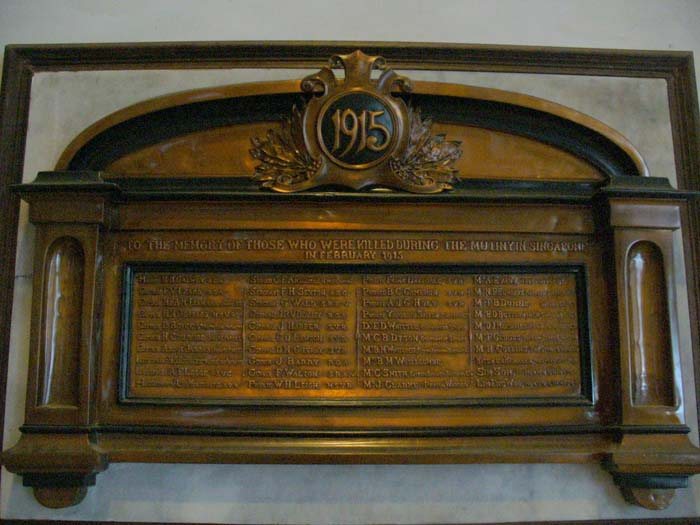
In November 1916 the lodge resolved to admit, for the duration of the war, men serving in the Territorials and the Volunteers, whose part in putting down the mutiny and in manning the island’s forts had been out of all proportion to their numbers. In May 1918 the Master and members sent forty-five dollars to King George’s Fund for Sailors. A hundred years later, on Thursday 6 December 2018, the lodge kept the centenary of the armistice at a special meeting, and remembered its own dead.
Civilians, 1920
After the war the flow of soldiers slackened and did not return to its old volume. In 1920 the lodge decided to admit civilians with no service connection at all, in order to keep itself alive. It is the most consequential decision in the lodge’s history, and it was taken quietly, as a matter of arithmetic. Everything Eastern Gate has been since — a lodge of many professions, nationalities and faiths, meeting in an independent republic — follows from it.
W. Bro. Pocock, the founder Master, had by then left Singapore. He resigned from the lodge in February 1922, and the members, realising what they had let pass, made him an honorary member the following month.
A chapter and a daughter lodge
A Royal Arch chapter attached to the lodge was first proposed in 1923 and thought likely to draw members away from the two chapters already meeting in Singapore. The idea was revived in 1930, fifty-seven companions signed the petition, the warrant was dated 5 November 1930, and the chapter was consecrated at Freemasons’ Hall on 20 February 1931.
The second offspring came from the crowded years after the Second World War. With a waiting list of candidates and no prospect of office for most of them, the lodge resolved in July 1958 to found a daughter lodge. It was to be called Pulau Brani, in honour of the founders and the island. The District Grand Master asked instead that it be named Centenary, to mark the hundredth year of the District, and so it was: warranted on 4 December 1958 and consecrated on 27 May 1959.
The war and the occupation
Japan entered the war on 2 December 1941. The last meeting of the lodge before the fall of Singapore was held on Saturday 24 January 1942, out of course and sparsely attended, many members being unable to leave their duty. Singapore capitulated on 15 February. Grand Lodge deemed the lodges of the Far East dormant from the end of 1941, and waived their dues.
Almost everything the lodge owned was lost: the warrant, the banner, the regalia, the museum pieces, and all but a handful of its records. Freemasons’ Hall was used as a grain store. Members were interned in Changi Gaol and at Sime Road, where the Deputy District Grand Master, W. Bro. Baldwyn Lowick, held the District together from inside the wire for three and a half years. When the roll was rewritten after the war, forty-six members could not be traced at all.
Eight brethren, April 1946
British forces landed on 5 September 1945. Four months later, seven members of Eastern Gate put their names to an application for a new warrant, written on the flimsiest paper imaginable, and sent it to London. On 10 April 1946 the District granted a dispensation to meet without either charter or regalia:
Further permission is hereby granted to Members to attend meetings of the Lodge without being clothed in the usual Collars and Badges of the Order which, it is understood, are not available.
The first of those meetings was held on 18 April 1946. Eight brethren attended, the smallest number in the lodge’s history, and no work was done. The lodge stood to order in memory of those who had fallen. By the May meeting there were eight members and nineteen visitors; the first ceremony was worked on 16 May, on behalf of a lodge in England; the first initiation since the war took place on 19 September, the candidate a master mariner of the Harbour Board.
The warrant of confirmation was issued on 1 May 1946 and presented to the lodge that December. It cost two pounds ten shillings, and Grand Lodge made no charge for replacing what enemy action had destroyed. In June 1947 the lodge bought twelve officers’ aprons for two hundred and fifty-four dollars and seventy-six cents.
Full years
The decade that followed was the busiest the lodge has known. Candidates came faster than the monthly meetings could absorb them, and emergency meetings were held almost every month into the 1960s. In April 1949 thirty-nine members and thirty-eight visitors attended a regular meeting; at the installation of 1953 there were a hundred and eighteen present. Membership reached its highest point, a little over two hundred, in 1961.
The garrison goes
The end came as the British forces went home. The last serving member of the forces stationed in Singapore to be initiated into the lodge was a warrant officer, on 20 May 1971; the last member of the British forces to occupy the Master’s chair was installed in July of the same year. The remaining troops and their families — some seventeen hundred people — left on 17 November 1975, and the band of the Gordon Highlanders played them out.
A lodge that had drawn its members from the garrison for seventy years lost that source entirely. Membership fell from about two hundred in the 1960s to roughly seventy by the time of the centenary, and it was only at the turn of the century that the decline stopped. What replaced the soldiers was the city: members of every race in the republic, and of professions the founders would not have recognised.
Charity
The lodge’s charitable record is long and, for a lodge of its size, disproportionate. It became a patron of the Royal Masonic Institution for Girls in 1952 and of the Institution for Boys in 1953, a patron of the Royal Masonic Benevolent Institution in 1965, a Grand Patron of the Royal Masonic Hospital in 1968, one of the first lodges to be made a patron of the Grand Charity, in 1983, and a patron of the New Masonic Samaritan Fund in 1992. A Lodge Benevolent Fund for brethren and their dependants in immediate need was formed in 1975, and what it does not need is given away to masonic and non-masonic causes in Singapore.
Giving has also come the other way. In the 1990s a member who had died left the lodge a bequest, paid over four years. It is held as the Roper Trust Fund and is used to help technical students, who are not Freemasons and need not be, to finish their education.
Six volumes on the pedestal
Nothing records the change in the lodge more exactly than the books on the Master’s pedestal. In 1948 a member gave the lodge a Bible. A member gave the Sri Guru Granth Sahib in 1968, another the Hebrew Torah in 1971, another the Bhagavad Gita in 1974, another the Qur’an in 1978, and another the Buddhist Sutras in the same year. Six Volumes of the Sacred Law now lie there, each of them the gift of a member of the lodge, and a candidate is obligated on the book of his own faith.
The lodge now
Eastern Gate was founded by sergeants of the Royal Engineers and the Royal Artillery on a garrison island that no longer has a garrison. It meets at Freemasons’ Hall, 23A Coleman Street, Singapore 179806, on the third Thursday of every month, under the District Grand Lodge of the Eastern Archipelago, and its members come from many countries and many callings.
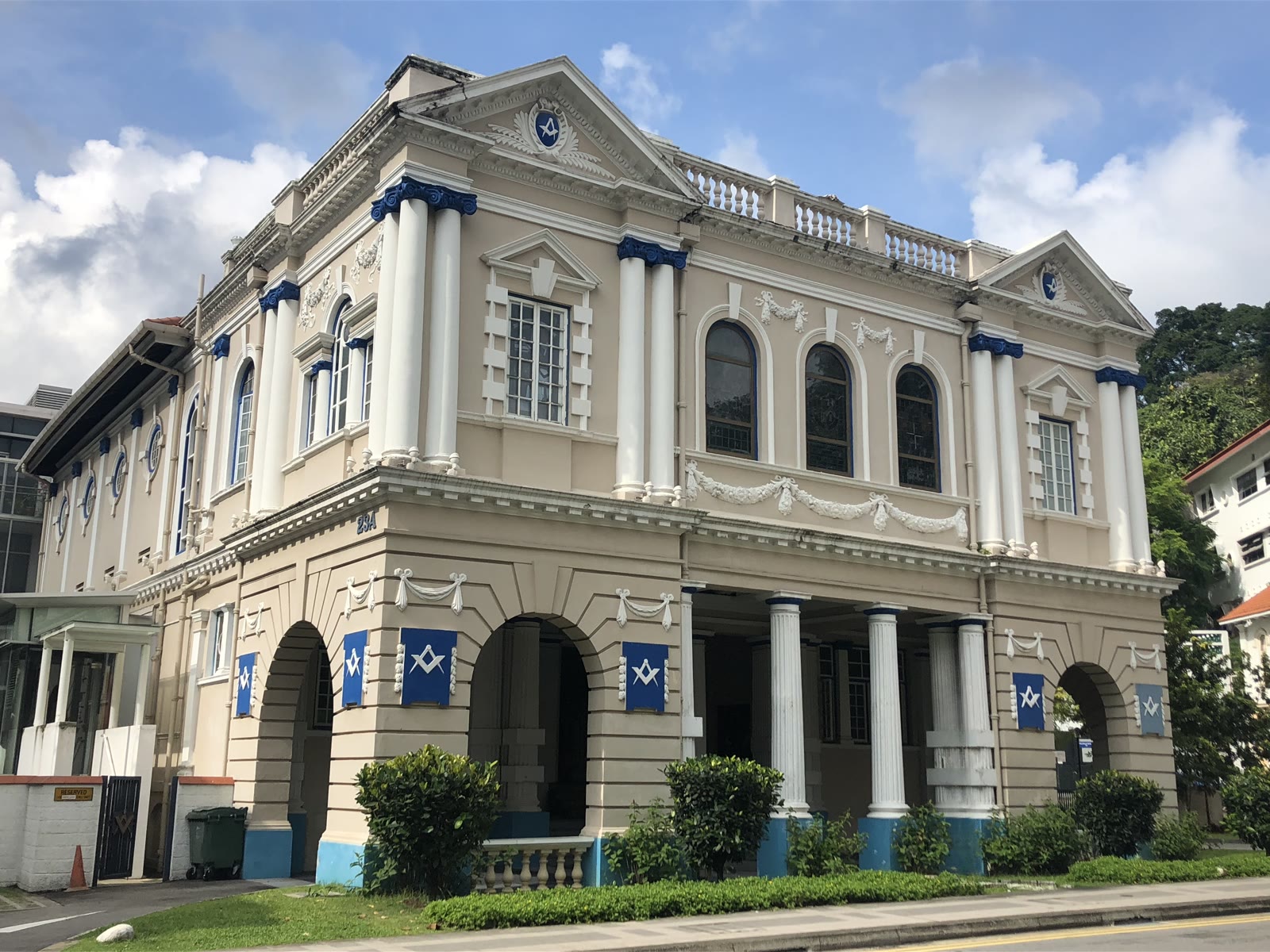
Two things are worth reading next: the story of the lodge’s five banners, on The Banner, and what was said and made for the hundredth year, on The Centenary. The name itself is taken up under Why Eastern Gate, and the building under The Masonic Hall.