
The Lodge Banner
Almost every lodge under the English Constitution has a banner, hung in the east of the room it meets in. Eastern Gate Lodge has had five of them since 1903. The first was a gift at the consecration, the second was paid for by members scattered across the world, the third was made in the year of a coronation when silk was still hard to come by, the fourth wore out in nineteen years of use, and the fifth was embroidered for the centenary and hangs there now.
Why a lodge has a banner
The account that follows is the lodge’s own, given by W. Bro. E. F. Mullan at the centenary celebration on Saturday 19 July 2003, and it begins with the obvious question: why have a banner at all, and is a relic of that kind still worth keeping?
Banners became usual in English lodges during the second half of the eighteenth century, but the practice behind them is far older. A symbol that could be recognised at a distance served as a rallying point in battle, or marked where a body of men was quartered in camp. The Assyrians, the Egyptians, the Greeks and the Romans all fought under their own devices, and the Colours of a regiment are still among the things soldiers hold most dear. Anyone who has walked into an English cathedral, or a parish church, has seen old Colours laid up there and treated with great care and no little pride. The founders of this lodge were soldiers, and they will have thought along those lines.
Out of the same practice came heraldry proper. The knight in full armour could not be recognised by his face, so he was recognised by his arms; as more men adopted the habit, designs clashed, precedence was disputed, and the disputes produced rules. The College of Arms was founded in London in 1484 to make and keep them, and remains the sole arbiter of arms granted in England.
A banner, Boutell’s Heraldry says, is a square or oblong armorial flag hung by one of its sides. Since it began on the battlefield, it can fairly be called the flag showing the armorial bearing of someone of importance, or the badge of honour of some place or group thought worthy of the distinction. That may sound grand for a lodge. But the wish to be identified with something, and to be known by it, is an ordinary human wish, and a banner is a plain way of meeting it.
A gate, with the sun rising behind it
Among the lodge’s papers is a small, worn card, headed “To be returned” in a firm hand. On it is a drawing of the lodge’s device — a gate between two pillars, a sunburst rising behind the arch, two stars, and the words EASTERN GATE LODGE No. 2970 set round the rim — and beneath the drawing, in ink, a few lines of explanation. It is signed and dated 8 May 1908.
This design is intended to represent:— A Gate (or Gateway) behind which the sun is rising; this is therefore representative of the lodge name ie. EASTERN GATE
The steps rising to the gate should be seven in number
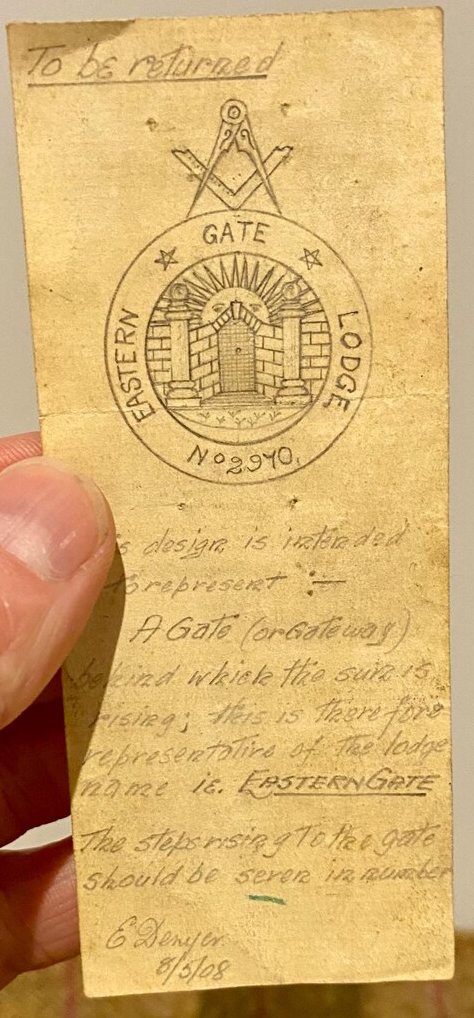
It is the earliest statement the lodge has of what its own emblem means, written five years after the consecration, and every banner since has been built on it. The seal the lodge uses today still shows the gate and the rising sun.
Five banners
1903. The first banner was presented at the consecration by the District Grand Master, R.W. Bro. Sir Walter Napier.
1938. By the end of the 1930s the first banner was failing. The lodge’s annual report of the time notes, with the affection soldiers reserve for worn-out things, that it was fading away like all good soldiers, and records the valiant efforts made to hold it together with glue and bandages. Money for a replacement was sent in by members from all over the world, and the new banner followed the original design as closely as anyone could then determine. Its life was short: it was lost during the Japanese occupation of Malaya and Singapore a few years later.
A miniature banner had also been obtained in 1927, for District meetings held away from Singapore, to save the main one from the journey.
1954. A quotation for a replacement was sought from England in 1949. The makers replied that they very much regretted that, owing to the difficulty of obtaining the necessary banner silk and very acute labour difficulties, they were at that moment unable to quote. Rationing and then the Coronation kept them busy; the quotation did not arrive until late in 1952. The lodge proposed to pay from its own funds, and withdrew the motion when a senior Past Master said he would buy the banner himself. It was unfurled at a meeting on 2 March 1954.
1973. Nineteen years of use in a tropical climate told on it. Notice was given in November 1971 that a new banner was needed, and delivery was expected to take eighteen months. The fourth banner was bought in September 1973 for eighteen hundred dollars, or two hundred and seventy pounds, out of lodge funds and members’ donations.
2003. The fourth banner was expected to last to the centenary, and it did, though poor handling had damaged it. The lodge decided to mark its hundredth year with a new one.
The banner of 2003
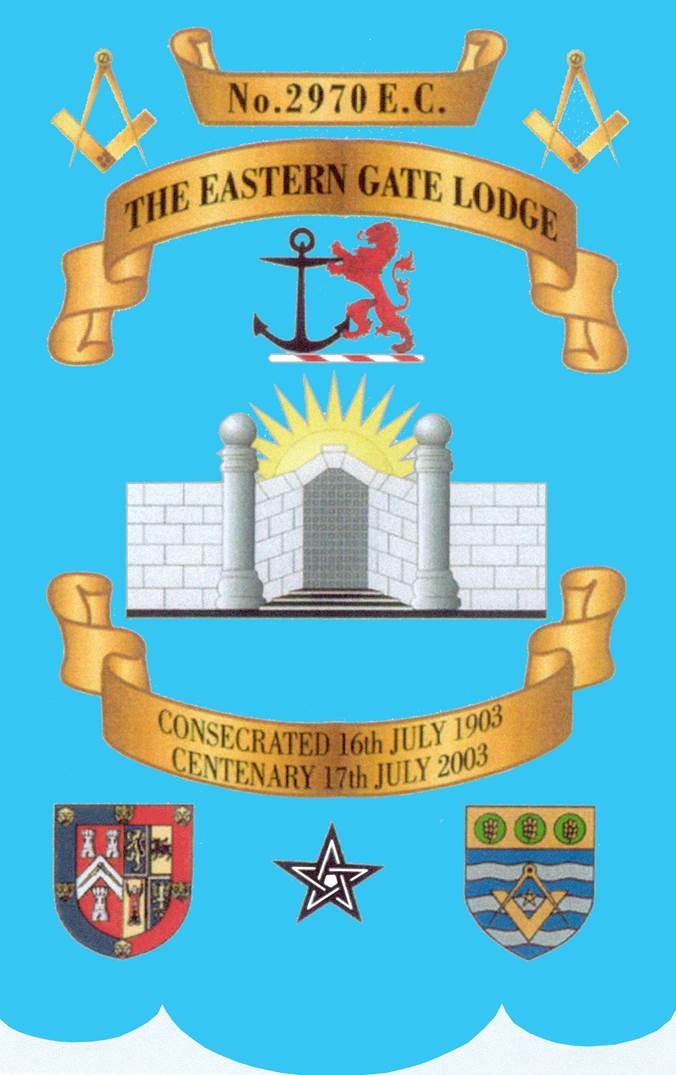
The design was taken back to the beginning. A photograph survives of the temple as it was about 1906, with the original banner in it, and the new banner follows that layout closely. A few things were added, on the principle that a lodge’s emblems may develop as the lodge does.
It is embroidered on blue silk, the traditional colour of the Craft. Singapore, the gateway to the East then as now, is shown as a gate between two pillars, each surmounted by a globe — one terrestrial, one celestial. The sun rises in the east behind the wall and the gate. The Volume of the Sacred Law, which the original did not show, lies at the foot of the three steps leading up to the gateway. The square and compasses stand at the head of the banner. At the foot are the arms of the District as granted after the Second World War and as approved by Grand Lodge in 1995, with a pentagram between them; the District’s older lion-and-anchor seal, in use until 1949, was brought back above. Two scrolls carry the dates: the consecration, 16 July 1903, and the centenary, 17 July 2003.
The banner was made by the embroidery department of the United Grand Lodge of England at Great Queen Street, in London, and given to the lodge by three of its Past Masters. At the centenary celebration on Saturday 19 July 2003 it was carried into the lodge, unfurled, and paraded so that everyone could see it. The old banner was then taken out to the side temple, and the new one hung in the east in its customary place.
The recommendation made that evening was that the worn banner be kept, behind glass, as the old banner of Zetland in the East — the mother lodge of Eastern Gate — has been kept, so that a relic of the past is not simply thrown away. And the address ended where it had begun. A lodge banner may be something of an anachronism. It is also part of the lodge’s traditions, and tradition still has an important part to play in the fellowship of a society of this kind.
The years the banners span are set out on The Lodge, and the hundredth year itself on The Centenary.